
Iconic architecture along EuroVelo 19 – Meuse Cycle Route
To explore modern icons, medieval forts, and World War memorials, all providing a deep dive into the rich history of the Meuse River region, we prepared a list of sites along EuroVelo 19 – Meuse Cycle Route that you should not miss.
France
Haute-Marne Department
EuroVelo 19 could not begin in a better spot with architectural significance. The town of Langres is framed by 3.5 km-long ramparts, making it one of France’s finest fortified towns. If you are interested in fortified architecture, you are on the right track! While cycling EuroVelo 19, you will discover much more as you cycle further north.

Vosges Department

Directly on the route in the Vosges Department lies the birthplace of one of France’s greatest historical figures – Joan of Arc. In the village of Domrémy-la-Pucelle, the Basilica of Saint Joan of Arc was built from a combination of pink Vosges granite and Euville stone, and it showcases eight large paintings depicting Joan’s life. You can still find her family’s simple four-room farmhouse in the village too.
Sites associated with Joan of Arc will accompany you even further on the route. Particularly in the Meuse Department, in the town of Vaucouleurs, lies Porte de France, a place that marks the starting point of her epic journey in 1429.
Meuse Department

A variety of architectural landmarks are located in the Meuse Department: from Châteaus, fortifications to medieval sites.
To admire fairy-tale-like architecture, visit Château de Montbras, Château des Monthairons, and Château de Commercy – which is visible right from EuroVelo 19 and was built on the ruins of a medieval fortress and got its modern Baroque look in the early 18th century. The local legend says that the ‘madeleine’ were born inside its kitchens.
Fortified places to visit are Fort de Vaux, Fort de Douaumont, and the Fortified Church of Dugny-sur-Meuse. We also recommend two impressive Notre-Dames in the region: The Church of Notre-Dame de Mont-devant-Sassey and the Church of Notre-Dame de Bonne Garde.
Verdun
Verdun is a city worth a stop for architectural lovers. Its architecture was influenced by Vauban’s defensive schemes, for which he built a network of canals along the river Meuse, and which are an essential part of the city’s image.
Along the streets, you will notice a blend of historical and contemporary design. From the Cathedral of Notre-Dame – France’s oldest cathedral dedicated to the Virgin Mary – to the 17th-century citadel, and the riverside area Quai de Londres – showcasing 1930s modernism features and rebuilt after the First World War.

The Battle of Verdun was one of the biggest battles during the World War I. But the city had built strong defensive systems even before, making it one of the greatest defensive systems in Europe, as mirrored in its architecture. Two concentric belts of fortifications, stretching across nearly 70 km and incorporating 28 forts and defensive works, numerous shelters, artillery batteries and infantry positions, including iconic Fort de Vau and Fort de Douaumont.
From 1967, the Verdun Memorial underwent a major architectural transformation that introduced a contemporary architectural language more closely connected to its surroundings. Thanks to the new design, when standing in the exhibition areas, you can now directly look at what once was a battlefield.
Another proof of Verdun’s architectural diversity is, for example, Aquadrome – a contemporary glass-and-steel complex opened in 2008 – as well as the modern Church of Sainte-Jeanne-d’Arc, distinguished by its sculptural concrete forms.
French Ardennes
In the north of the country, the Ardennes region is home to historic cities and towns showcasing centuries of architectural heritage. Givet has one of the largest fortresses in northern France – Fort de Charlemont, while the medieval town of Sedan houses Europe’s largest fortified medieval castle. The historical centres of the cities of Mouzon and Charleville-Mézières are filled with remarkable architectural landmarks.

-
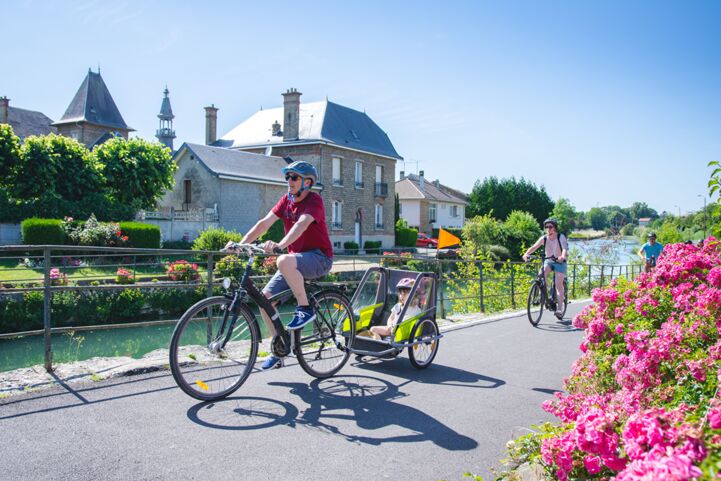
Mouzon © Pierre Defontaine -
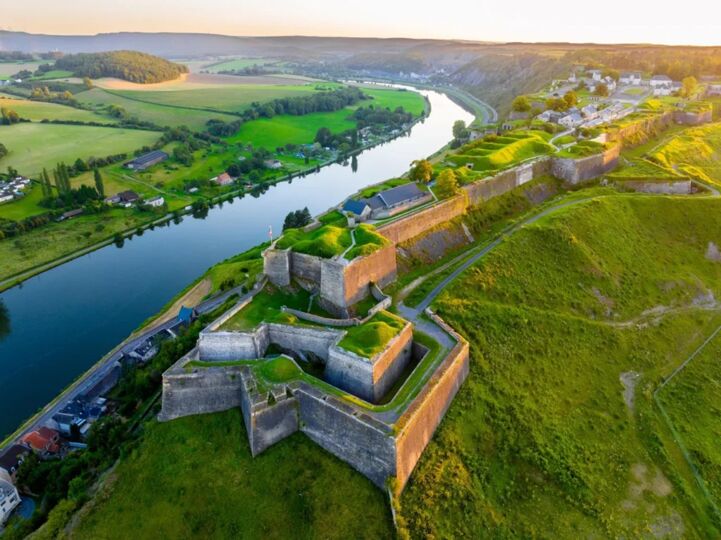
Fort of Charlemont. ADT08 - ©Loïc Lagarde


Belgium
Wallonia

In the Wallonia region, as you pass through the city of Dinant, an imposing citadel stands on the rocks overlooking the city, ready to defend it whenever needed – as it has over the centuries. Another impressive citadel is spread over the capital of Wallonia – Namur. Both Namur and Dinant citadels, together with the ones in Huy and Liège, form a group of so-called Meuse citadels – built originally as forts by the river Meuse to protect the area and its emperors.
Modern architectural sites can be found in Liège. A skyscraper decorating the sky of Liège, Tour Paradis, cannot be missed on EuroVelo 19, as it is one of the tallest buildings in the entire Belgium!

Not so far from there lies the most iconic landmark of the city. If you are arriving or departing from Liège by train, you will most certainly not miss Liège-Guillemins Railway Station. Its modern design, dominated by a massive arch, makes passersby feel like they are in some futuristic movie, and not on EuroVelo 19.
Water Castle of Pietersheim
Similarly to France, Belgium has some medieval fortress sites along the route as well. One of them is the Water Castle of Pietersheim in Lanaken, surrounded by moats and woodland. In the past, it held an important strategic position guarding the crossing of the Meuse Valley, and nowadays, it is a reminder of the era of queens, knights, and noble families.
Bridge of Vroenhoven

Moving from medieval architecture to modern engineering, less than 10 km south of Lanaken, the Bridge of Vroenhoven hangs over the Albert Canal. And it represents more than an architectural landmark: this is the very spot where the invasion of Belgium in May 1940 by Nazi Germany began. What is more, the bridge’s second story tells a different tale: one about its vital role in inland shipping. We recommend taking a break from cycling and visiting the tourist centre at the base of the bridge, which tells the dramatic story of the Bridge of Vroenhoven.
Limburg
The historic town of Maaseik showcases the Mosan architectural style originating in the area around the Meuse valley. The style is characterised by broad façades, natural stone window frames with cross-windows, wooden shutters, pronounced horizontal lines, and deep roof overhangs. Mosan style peaked during the 17th and 18th centuries in what is now known as Dutch and Belgian Limburg. If on your way along EuroVelo 19 you will pass by noble residences, monasteries, castles, farmsteads featuring broad façades, natural stone window frames with cross windows, wooden shutters, pronounced horizontal lines and deep roof overhangs – you know you are in the right spot.

Netherlands
One of the greatest Dutch architects who designed some of the most famous buildings in the Netherlands, such as the Rijksmuseum and Amsterdam Central Station, will celebrate his 200th birthday in 2027.
The work of Pierre Cuypers is spread across the entire country, with some sights sitting right along EuroVelo 19. And their location along the river is not a coincidence. Cuypers used the Meuse River to transport materials, as well as a source of inspiration. The river was essentially his “highway”. Cycling along EuroVelo 19 in the Netherlands, therefore, brings you to a 400 km open-air museum of Cuypers' finest architectural work.
Van Hart Region
The discovery of his work begins in his birthplace, as well as his final rest place, only a few kilometres behind the Belgian border. The city of Roermond is home to the Cuypershuis museum. As part of the 200th anniversary celebration, during the 2026-2027 season, a unique attraction will be exhibited there – the Royal Throne, designed for the Dutch King’s Speech from the Throne. Further, you can spot here one of his biggest restoration projects – the Munsterkerk church.

Hart van Limburg
The Hart van Limburg region is the richest location for the discovery of Cuypers’ work, with more than 22 buildings which he designed, restored, or influenced.

These include the distinctive tower crown on Abbey Church in the border town of Thorn, the former Town Hall in Stevensweert, St. Medardus Church in Wessem, St. Amelberga Basilica in Susteren, or Our Lady of the Nativity Church in Kessel.
As you follow the route to the north, you pass by the city of Venlo, where Cuypers led extensive restoration works on St. Martin’s Basilica. Further, the route takes you through Sint Agatha Convent and its St. Agatha Monastery Church, another of Cuypers’s works.
St. Willibrord Church, located 30 km further in the town of Demen, holds particular significance to his work, as this is the oldest surviving example of his original designs.
Before reaching the end of EuroVelo 19, the last stop with a strong Cuypers’ presence imprinted on the building is in the historical centre of the city of Dordrecht, where he led several façades and restoration projects.
The heart of modern architecture
The voyage of the architectural gems along the EuroVelo 19 could not end in a better place than in the heart of modern architecture – Rotterdam.

But before reaching Rotterdam, step inside a human-made mountain of glass in the city of Spijkenisse on the isle of Voorne-Putten. De Boekenberg Library is an example that being inside might sometimes feel like being outside. Trees growing alongside streetlamps, and each floor feeling like a street in a traditional farmyard, completed with its own “house numbers.” The building was designed as more than just a library: as a social hub for wandering, meeting others, attending exhibitions and lectures or activities for kids.

Moving towards the finish line, in the port of Rotterdam, stands Portlantis, a fascinating example of contemporary architecture. Although the interior, unfortunately, is not freely accessible to visitors, the rooftop is (during the day). It offers views over the Port of Rotterdam, the Maasvlakte (human-made extension of the port of Rotterdam), and the North Sea.
Wherever you cycle in and around Rotterdam, be prepared to look up and marvel at some of the best contemporary and award-winning architecture in the world. After completing the Meuse Cycle Route, architecture enthusiasts will have plenty to see here. Not by any chance, the route concludes just in front of the iconic Rotterdam Central train station.

The list of iconic architecture along EuroVelo 19, however, is much longer than space on our list. And so, when cycling along the river Meuse, we guarantee that you will never be short of views of interesting buildings and sites bearing historical weight.
Article by Barbora Labudová