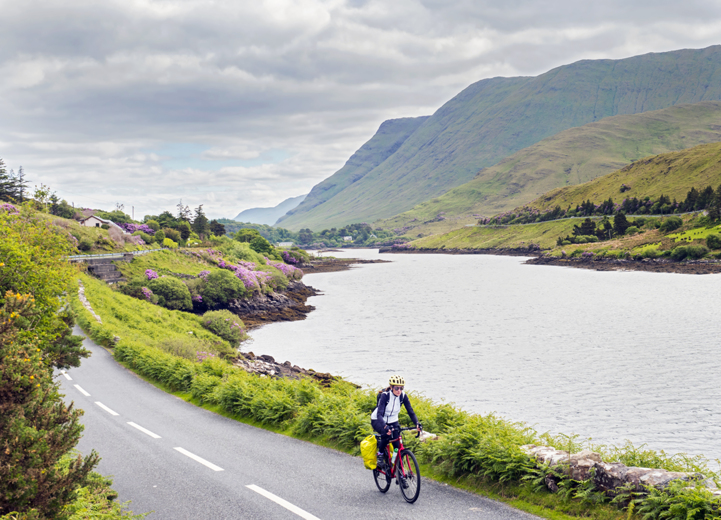
EuroVelo 1 – Atlantic Coast Route (2,500 km) follows Ireland’s rugged Atlantic coastline, mainly on quiet roads with some traffic free greenways. Expect stunning scenery, rich heritage, and authentic Irish culture—stop for a Guinness or enjoy traditional music along the way.

The route starts (or ends) at Rosslare Harbour, with ferry connections to the UK, France, and Spain. Travelling north, after 2,300 km in the Republic of Ireland you can continue into Northern Ireland, through Derry/Londonderry and travel for 220 km through rural landscapes to Belfast. From there, ferries go to Scotland, and trains or buses connect to Dublin.

The route is accessible by train or bus at many points. Terrain varies: some sections are flat and easy, while others are hilly and better suited to experienced cyclists. Weather can be changeable—expect wind, rain, sunshine, but most of all a rewarding adventure.

Find all details about the route including downloadable GPX files here.

If you have any questions you can contact [email protected] or check out the EuroVelo Ireland Facebook Discussion Group.

Some stories from cyclists who have cycled the route can be found here.

Countries

Legend

Development status
  • Certified Section of at least 300 km that has successfully undergone the certification process in line with ECF’s European Certification Standard. It is the highest quality level on the EuroVelo network
  • Developed with EuroVelo signs Developed route (see category below) with continuous signing along the route, incorporating EuroVelo route information panels.
  • Developed Route developed for cyclists and signed in line with the respective national standard (i.e. it is part of a local, regional or national cycle network). There must also be a website providing information to users. Developed route can be heterogeneous in terms of infrastructure: type of cycling infrastructure, surface, width, gradients, etc
  • Under development Route containing sections that require further development (e.g. stretches on public highways with high levels of traffic). Cyclists are advised to use public transportation to skip these non-developed stretches.
  • Planning Undeveloped route with no detailed information publicly available on the Internet. The itinerary communicated is a proposal for the best possible option currently available. It may also contain dangerous sections. Cyclists are advised to use public transportation to skip these non-developed stretches.
  • Public transport link

Markers

  • Natural Heritage
  • UNESCO World Heritage Site
  • Cultural Heritage
  • Culinary Delights
  • Maritime Heritage / The Rhine / The Meuse
  • Other Point of Interest
  • Service
  • Bus station
  • Train station
  • Mobility info center

National & Regional Information

Cycling Ireland

National EuroVelo Coordination Centre

Cycling Ireland is the National Governing Body for cycling on the island of Ireland, recognised internationally by the UCI and UEC. Cycling Ireland operates across all cycling disciplines and is dedicated to promoting, developing, and organising cycling activities. Cycling Ireland receives support from both governments on the island of Ireland. Cycling is considered one of the three priority sports within the Irish Government’s National Sports Policy 2018-2027. The National EuroVelo Coordination Centre and management of EuroVelo routes in the Republic of Ireland is led by the EuroVelo Route Manager based in the Development and Participation Unit of Cycling Ireland. Eurovelo in Northern Ireland is managed by Sustrans.

Visit Site

EuroVelo Ireland

This is the national website for EuroVelo routes in the Republic of Ireland. This website provides detailed information, maps and points of interest for EuroVelo 1 - Atlantic Coast Route and EuroVelo 2 - Capitals Route.

+353 86 8571008
Visit Site

Discover Ireland

This website is provided by Failte Ireland, the national tourism body in Ireland. It provides tourism information targeted at domestic tourists.

1800 230 330
Visit Site

Irish Cycling Campaign

Irish Cycling Campaign is an ECF member and part of the Irish National EuroVelo Coordination Centre. Since 2008 it advocates for cycling to be a normal part of life in Ireland - both everyday cycling and recreational / tourism cycling. It has branches in Ireland's cities and in many towns and rural areas. These include greenway promotion groups and bicycle festival organisations.

Visit Site

Tourism Ireland

This website is provided by Tourism Ireland which is an all-Ireland tourism organisation promoting tourism on the island of Ireland both in the Republic of Ireland and in Northern Ireland. This website is targeted at overseas visitors to Ireland.

Visit Site

Sport Ireland Outdoors

Sport Ireland Outdoors works with sporting bodies and other organisations to develop and promote outdoor activity sports. Sport Ireland also support the development of walking and cycling trails. This website and provides a search facility to find all recognised walking and cycling trails/routes in the Republic of Ireland.

+353 1 8608800
Visit Site

Transport Information – Ireland

This page from euroveloireland.ie provides a guide to travelling by public transport in Ireland

+353 86 8571008
Visit Site

Great Western Greenway

Website for the Great Western Greenway – Co Mayo provided by Mayo County Council.

+353 (0) 94 9064000
Visit Site

Kingdom of Kerry Greenways

Website for the Greenway from Listowel to the County Limerick border near Abbeyfeale where the greenway continues as the Limerick Greenway to Rathkeale in Co Limerick- and the South Kerry Greenway - provided by Kerry County Council.

+353 66 718 3500
Visit Site

Limerick Greenway

Website for greenway from the Co. Limerick border (near Abbeyfeale) to Rathkeale in Co Limerick - provided by Limerick County Council.

+353 61 556000
Visit Site

Midleton Youghal Greenway

Website for the Midleton Youghal Greenway provided by Cork County Council.

+353 21 427 689
Visit Site

Wild Atlantic Way

The Wild Atlantic Way (WAW) is a signposted tourism route on the west coast of Ireland It showcases the coast and includes attractive location along the way know as ‘Discovery Points’. While some cyclists follow the route unlike EuroVelo 1 – Atlantic Coast Route the WAW was not specifically designed or intended for use by cycle tourists. Both routes visit many of the same locations but not always using the same route. While the WAW often follows a route most suitable for driving between two locations, the EuroVelo route may follow a different route on very small roads with little or no motor traffic. In this context EuroVelo 1 could be considered as the cycling alternative to the WAW route. The link to the WAW website is provided here to allow EuroVelo 1 users to see the WAW route and to determine if they would like to deviate from the route and follow the WAW to locations that are not visited by EuroVelo 1.

Visit Site

Related news